
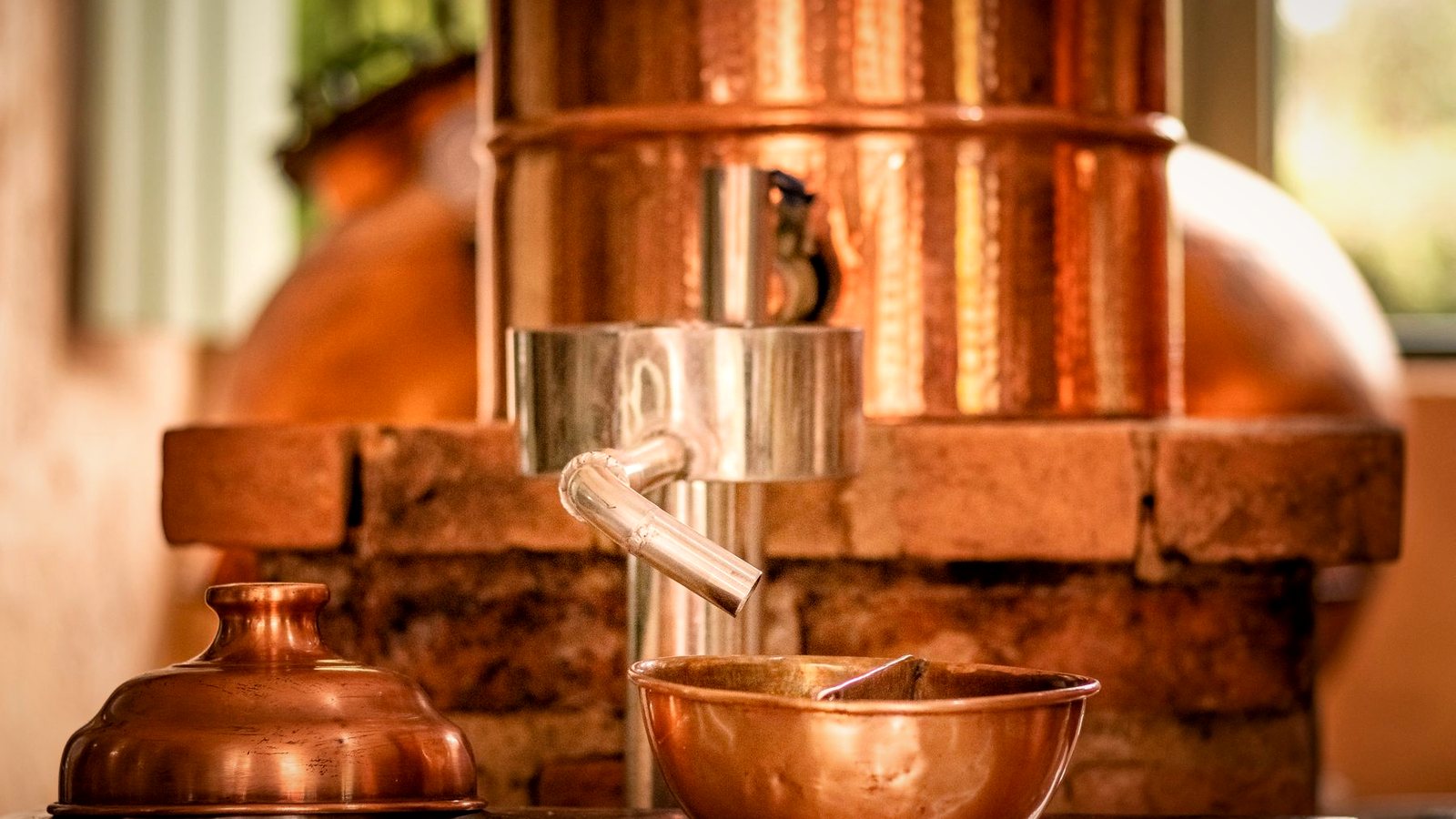
Mezcal does not come from a machine that takes agave in at one end and delivers a bottle at the other. It comes from a sequence of tools, some of them centuries old, each doing one job and handing the result to the next. After the agave has been cooked in a stone-lined conical pit oven, three of those tools take over: the tahona, the wooden tank and the copper still.
The tahona
A tahona is a large, heavy stone wheel. Once the cooked agave comes out of the pit oven, it is soft, sweet and carries a trace of smoke. The wheel rolls over it, crushing the fibers and pressing out the sugary juice and pulp that will become the base of the spirit. Traditionally the wheel is pulled around a circular pit by an animal such as a horse or a mule.
Why use a stone wheel instead of something faster? Mostly because it is a traditional way to mill, and it fits a craft that values patience. Aldez Mezcal is milled with a tahona. The wheel works slowly, and that suits agaves that spent 7 to 18 years growing before they were harvested.
The wooden tank
Crushing gives you sweet liquid and fiber. Fermentation turns that sweetness into alcohol. At Aldez, this happens in wooden tanks, and it is a natural fermentation. In plain words, no commercial yeast is brought in. The yeasts that do the work are already around, on the agave and in the surroundings, and they take the time they need. Fermentation takes the time it takes, and it is not hurried.
That patience is part of the point. Ensamble is a blend of three agaves, and every production is unique, a reminder that this is handmade work and not a formula run on a timer.
The copper still
Next comes distillation, and the still is a pot still made of copper. Copper is a traditional metal for stills for good reasons. It carries heat well, and it is widely said to help clean up certain sulfur-like flavors that can show up in a spirit, which makes the result smoother.
The mezcal is distilled twice. The first pass separates the alcohol from the fermented liquid and gives a lower-strength spirit. The second pass refines and concentrates it, so that the flavors are cleaner and the strength is higher. A distiller watches closely during that second run and decides which part of the spirit to keep.
After that, the mezcal is mixed with water to reach the strength you find on the label: 45% ABV (90 proof) for Ensamble and 44% ABV (88 proof) for Espadín. Then it is bottled and labeled.
What you taste
You can follow each tool into the glass if you slow down. The pit oven and the cooked agave show up as campfire and subtle smoke in Ensamble. The agave itself, wild and cultivated, speaks through green apple and pear in Espadín, herbal notes and cinnamon from Jabalí, and cacao from Tobalá. The tanks and stills sit behind all of it, shaping the finish: long, warm and semi-sweet.
Next time you pour a glass, pick one sip and ask what it owes to the stone wheel, the wooden tank or the copper still. Quench your curiosity, and Experience More.
Please enjoy responsibly.